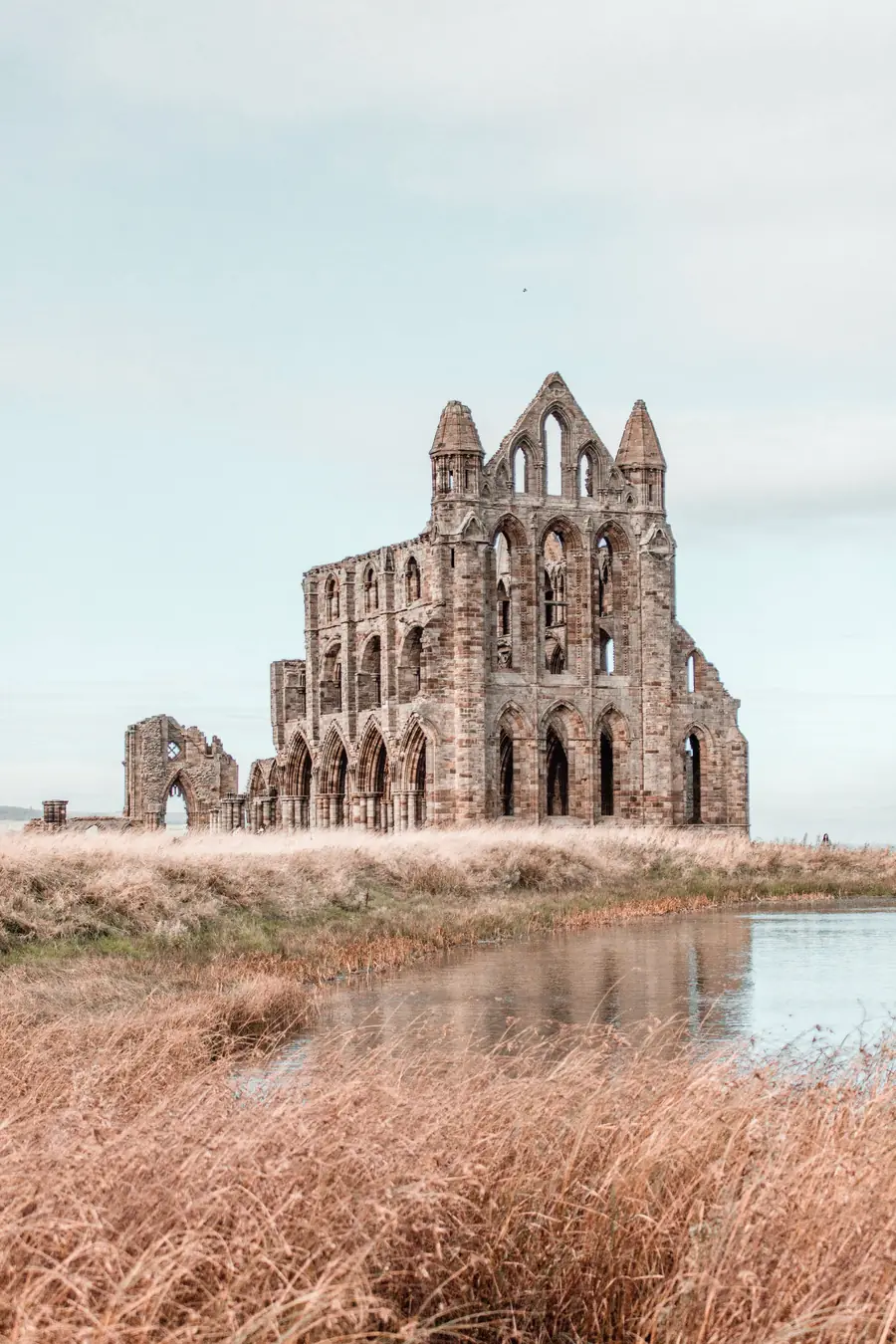
Whitby Abbey is the ruined Benedictine church standing on the East Cliff above the harbour, on the site of a monastery founded in 657 that hosted the Synod of Whitby and gave shelter to the poet Cædmon. It is an English Heritage site with paid entry, and it earns an hour — but the silhouette most people come for is free from St Mary’s churchyard next door, and plenty of visitors go no further than that.
The first monastery here was founded in AD 657 by Oswy, King of Northumbria, under the name Streoneshalh, the older name for Whitby. He appointed Hilda — abbess of Hartlepool and grand-niece of Edwin, the first Christian king of Northumbria — as its founding abbess. It was a double house of monks and nuns, and it was home to Cædmon (614–680), described in the sources as the great Northumbrian poet.
In 664 the Synod of Whitby met here to settle whether the Northumbrian church would keep the older 84-year Easter cycle used at Iona or adopt the newer 19-year calculation recently taken up at Rome. The tonsure worn by clergy and monks was argued over too. With Oswy’s backing, the decision went to the Roman reckoning already used in the English kingdoms to the south.
Danish raids between 867 and 870 laid the monastery waste, and it lay desolate for more than two centuries. Reinfrid, a soldier of William the Conqueror turned monk, was granted the ruined site by William de Percy and refounded it under the Benedictine rule; most of the Norman fabric was pulled down and the church rebuilt on a larger scale in the 1220s. It is that rebuilt church you now walk through. Henry VIII’s commissioners took the abbey and its possessions during the dissolution, and it was destroyed in 1540. Sir Richard Cholmley bought it; his descendants, the Stricklands, passed it to the government in 1920.
Two more things stay with you. The abbey’s arms were three coiled “snake-stones” — the local ammonite fossils, drawn with serpents’ heads. And in December 1914 the ruin was shelled by the German battlecruisers Von der Tann and Derfflinger, whose gunners were aiming for the coastguard station at the end of the headland; the buildings took considerable damage in a ten-minute attack. Bram Stoker’s Dracula, published in 1897, put the abbey into the novel through Mina Harker’s diary, which describes “a most noble ruin, of immense size”.
The ruins sit inside a paid English Heritage enclosure. Beyond the shell of the church there is a museum in Cholmley House, the 17th-century Cholmley banqueting hall reworked by the design studio Stanton Williams in 2002, plus a shop and toilets; an audio guide is available. Six of the forty reviews in our sample mention the museum favourably — one in July 2026 called it “first class” — and one visitor in June 2026 advised walking “away from the coast around the pond to get a great view back of the Abbey”.
Allow about an hour. One visitor in June 2026 took “about 45 mins to walk around and take photos”; another in April 2026 put it at “around an hour to explore”. A visitor in July 2026 was blunter: “you can get round them quite quickly so it’s not a day out.”
The abbey is exposed on every side — good for photographs, cold in a wind, and worth watching your footing in winter — a January 2026 visitor found the ruins “open to the elements” and advised “careful footing”. English Heritage runs an events programme on the headland, including autumn illuminations after dark and daytime Dracula performances in summer; both the programme and admission change, so check the official English Heritage page before you go.
From the town centre the classic approach is the 199 Steps, which climb from Church Street in the old town to St Mary’s churchyard; the abbey lies just beyond it. English Heritage’s car-free travel partner puts the walk from Whitby bus station at about 15 minutes by this route. The bus station and Whitby’s railway station sit together about 0.2 km from the town centre, so arriving without a car works end to end.
To skip the steps, drive round to the Abbey Headland Car Park (YO22 4JT, run by North Yorkshire Council), which sits on the cliff-top behind the site; from there it is about 330 m to the abbey on a made-up path — a June 2026 reviewer describes “solid pathway all the way up to the abbey”. Several reviewers recommend this specifically for anyone with limited mobility.
Google rates it 4.6 from 15,360 reviews. From the 40 most recent in our sample:
Yes, to enter the ruins — Yes, to enter the ruins — it is a ticketed English Heritage site; check the official English Heritage page for current admission before you go. St Mary’s churchyard and the headland beside it are not part of the enclosure, and several visitors say the view from outside the walls was enough for them.
An hour covers the ruins and the museum comfortably. Reviewers report anything from 45 minutes to several hours if you add the café, the shop and the cliff-top walk.
Yes. Drive or take a taxi up to the Abbey Headland Car Park behind the site and walk in on the level. Three reviewers mention the open-top tour bus as a way to avoid the climb; one, in June 2026, took it up and walked down the 199 steps afterwards.