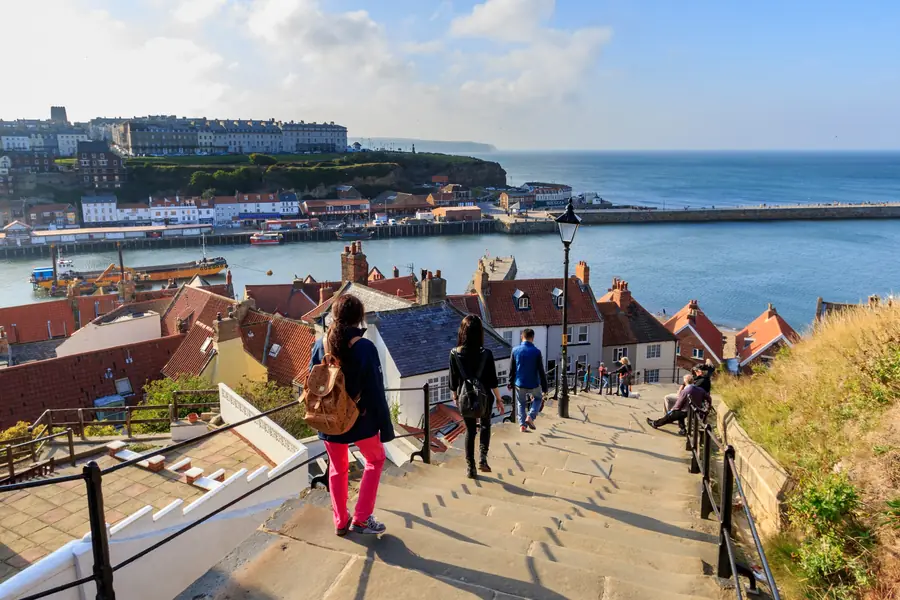
A stone staircase of 199 steps climbing from Church Street in the old town to St Mary’s Church on the East Cliff, with Whitby Abbey a short walk beyond, recorded since 1370 and Grade I listed. It costs nothing, two reviewers put the climb at five and ten minutes — PartTimeTraveller in December 2025 said “one can climb within 10 mins”, and it is the single walk that makes sense of how Whitby is laid out — but it is a real climb, and reviewers genuinely disagree about how hard.
The steps are also known as the Church Stairs, the Church Steps and Jacob’s Ladder. The first written mention is usually dated to 1370, though Visit Whitby puts the first record at 1340, though the pathway is assumed to be older still: the Church of St Mary has stood on the clifftop since the 12th century. Until around 1774 the steps were made of wood and painted brightly. An act of 1764 required the owners to pave the route, and 103 tonnes of stone were brought from a quarry at nearby Sneaton.
This was the direct route for funeral processions from the town to the churchyard. Level platforms still survive at intervals on the ascent, built so that pall-bearers could rest the coffin and get their breath back. The last coffin believed to have been carried up this way was that of a former rector of Whitby, the Reverend George Austen, whose funeral was in 1933. Today those platforms carry benches and are used by anyone who needs a pause.
The climb was also read as a measure of Christian determination — the congregation’s struggle up reminded Sir George Head of Bunyan’s Hill of Difficulty. Some of the infirm simply could not manage it, which contributed to a new church, St Ninians, being built on the west side of town in 1778.
The count has been argued over for centuries. John Wesley climbed them to preach and declared there were 191; other historians said 190, and some guidebooks printed 194. Visit Whitby notes records claiming 198 and 200 as well. The matter was settled in 1877, when after a major restoration the churchwardens entered 199 in their records. Every tenth step, and the final one, now carries a small circular disc stamped with a Roman numeral so you can keep count.
An 18th-century act bringing roads and paths under local authority control left the steps out, so they remain the responsibility of St Mary’s parochial church council. They were renovated in 1988 at a cost of £12,485, including a donation from the Prince of Wales. In 2004 the lower end was found to be sinking; a public appeal raised the money from 199 donors of £1,000 each. Bram Stoker put the steps in Dracula — the black dog that comes ashore from the wrecked Demeter runs up them to the churchyard.
From the bottom on Church Street the flight rises in a long, slightly turning line, with handrails and the resting platforms breaking it up. The steps are shallow and wide, which is why the pace varies so much between people, and the view opens gradually behind you: the harbour, the rooftops of the old town, the piers and the sea. At the top are St Mary’s churchyard, its salt-scoured headstones, and the abbey ruins beyond.
Running alongside the steps is the Donkey Road, a cobbled slope that is Grade I listed in its own right, with a near-50% gradient. Most of its paving stones probably date from the 19th century, and the name may come from the beach donkeys being walked down each morning and up again each evening. Treat it as a curiosity, not as a step-free option: the cobbles are steep — Claire Cronin’s “daring enough” is the operative word. Visit Whitby’s own page points anyone not up to the climb towards the town’s open-top tour bus instead.
There is no charge to use the steps. The abbey at the top is a paid English Heritage site; check the official pages before you go rather than trusting anything printed here. Full history and the count dispute: visitwhitby.com.
The foot of the steps is on Church Street at 54.4890, -0.6117, about 360 m from the centre of town in a straight line — cross the swing bridge and follow Church Street north-east through the old town to Church Lane at the foot of the steps. Whitby railway station and the bus station both sit around 500 m away on the far side of the harbour. Church Street car park is about 340 m away on the same side of the harbour; Cliff Street car park is nearer in a straight line (about 290 m) but sits across the water on the West Cliff.; Endeavour Wharf is about 530 m. Whitby Abbey Headland car park, some 560 m off, is at the top of the cliff, so parking there means walking down the steps and back up. The Park and Ride is about 2.9 km out. Andy Singh, in May 2026, wrote simply: “Difficult to find parking.”
Google shows 4.8 from 4,515 reviews. Across the 40 Google reviews in our sample, seven say the climb was easier than they had expected, while about a dozen call it hard work — the split is real, not a matter of one grumbler.
That number was fixed by the churchwardens in 1877 after a restoration. Before that, counts ranged from 190 to 200, with Wesley reporting 191 and some guidebooks 194. The Roman numeral discs on every tenth step let you check for yourself.
No. The steps are a public route and free to climb. The abbey at the top is a separate paid attraction — check its official site for current details.
Not by this route. The Donkey Road alongside is cobbled and close to a 50% gradient, so it is not an accessible alternative. Whitby Abbey Headland car park sits at the top of the cliff, so the abbey can be reached by car without using the steps at all, and Visit Whitby points anyone not up to the climb towards the town’s open-top tour bus.