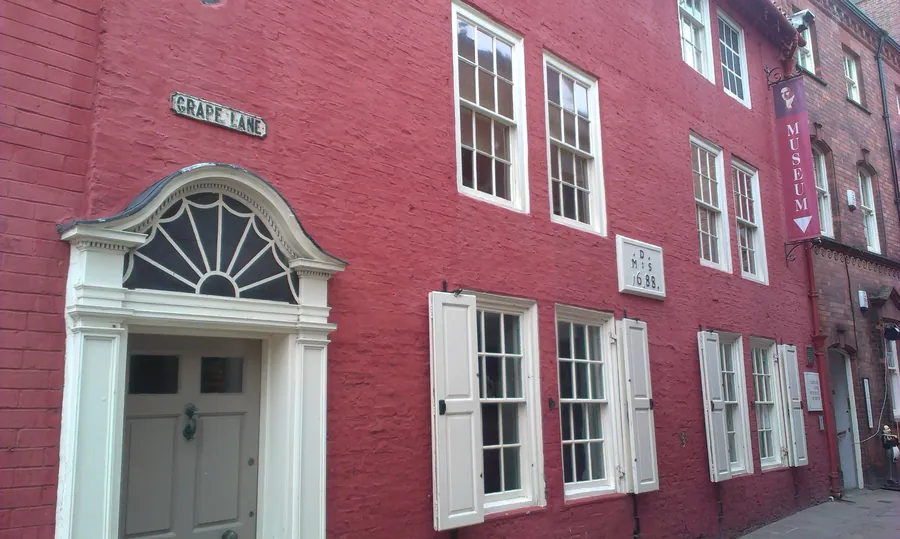
The house on Grape Lane is where James Cook is recorded as lodging during his Whitby apprenticeship, on the authority of a 19th-century account the museum sets out., and the museum inside it holds original letters, charts and voyage paintings alongside two ground-floor rooms refurnished to a 1754 inventory of the house. It is a small museum — the handful of reviewers who mention timing give it an hour to two — and it rewards people who like reading; opinion on how well it holds children is split (see below).
The building is Walker’s House, put up in 1688 by Moses and Susannah Dring according to the plaque on its wall, and bought in 1729 by the father of Captain John Walker, who made it both his home and the office of the family shipping business. It is a largish house on three floors with an attic, typical of a well-to-do ship-owner’s property of its period.
Cook was introduced to John Walker in 1746 by William Sanderson, the grocer he had worked for in Staithes, a fishing village nearby. Walker took him on as an apprentice seaman for three years; Cook went on to serve him as seaman and then master’s mate until he joined the Royal Navy in 1755, spending most of that time on Walker’s colliers in the coal trade between the Tyne and London, with voyages to the Baltic and Dublin. The Whitby historian George Young, writing his life of Cook in 1836, recorded that Walker on occasion kept Cook ashore in Whitby and lodged him in the attic of the Grape Lane house, where he studied by candlelight supplied by the family servant Mary Prowd.
It is the only visit to the town after 1755 that is known. In the winter of 1771–72, after the first voyage, he was staying at Great Ayton and rode over to see his old master. The household was lined up to greet him and told to behave. Mary Prowd could not manage it, threw her arms round him and said, “Oh honey James! How glad I is to see thee!”
The house stayed in the Walker family until the mid-19th century, then served in turn as a hospital and a private residence, and was rescued in 1986 by the Cook Museum Trust. An archaeological investigation in 2001 found the foundations of small buildings read as outbuildings of the Walkers’ shipping business, a herring-bone brick floor about a metre below today’s ground level — the “brick-floored room” listed in the 1754 inventory, its location previously unknown — and a slipway running down to the river, built over as the Walkers moved out of ship-owning into banking and insurance.
Three floors and the attic, worked hard. The two ground-floor rooms are furnished to that 1754 inventory and painted in the original colours. Above them the collection covers the voyages themselves: original letters including correspondence of Cook, Lord Sandwich, Sir Joseph Banks and the Forsters; paintings and drawings by the artists who sailed with him — Sydney Parkinson, William Hodges and John Webber; Pacific and New Zealand artefacts, original maps and charts, and ship models. William Hodges’s 1770s painting of Matavai Bay, Tahiti, which Cook visited on the second voyage, was bought by the museum in 2009 with help from The Art Fund and other charities.
It is not only Cook. One visitor in September 2025 noted “interesting historical facts on navigation, medicine etc too”, and another in August 2025 found “information on life at sea including surgical equipment and information on scurvy”. There is a video presentation in one of the upstairs rooms, a shop at the entrance, and a rear courtyard looking over the harbour. The attic where the apprentices slept is reached by a creaking wooden staircase; two reviewers warn you to mind your head going in.
Opening times vary through the year, so check the official site before you set off: cookmuseumwhitby.co.uk
The museum is at 54.4867° N, 0.6117° W, on Grape Lane on the harbour side of the east bank — over the swing bridge from the main shopping streets, then off Church Street. From Whitby railway station it is about 300 metres in a straight line, but the walk crosses the swing bridge upstream, so allow rather longer on foot; the bus station adjoins the railway station, so arriving without a car works. Church Street car park is the closest, roughly 90 metres away, with Endeavour Wharf about 280 metres and Marina Front about 360 metres. Whitby Park and Ride sits 2.8 km west if you would rather not drive into the old town at all.
It slots neatly into the east-side walk: the foot of the 199 Steps is about 260 metres away, and Whitby Abbey about 310 metres in a straight line, though that one is up the cliff.
It holds 4.5 from 730 Google reviews.
Sixteen of the forty reviews in our sample single out the staff or volunteers by name or role — the strongest single theme by a distance. A visitor in April 2026 credited “Steve, enthusiastic volunteer… so knowledgeable about every piece that was exhibited, and even went to do some extra research on one of our questions he could not answer at first.”
On timing, accounts split. One visitor in July 2026 said there was “enough inside for about an hour”. Another, in May 2024, disagreed: “You need a couple of hours at least to see and absorb everything.”
The sharpest dissent is a single two-star review on value against length. A two-star review in September 2024 said, “You spend there 30 minutes to one hour and most of the reading things can be found online. I don’t think it’s a good value.” A separate gripe from October 2020: “a lot of the written historic stands the lettering was a little small for me to read.”
Children are a real question. One parent in July 2022 reported their nine-year-old finished the paper treasure hunt in twenty minutes while the adults were still reading, and concluded: “Perhaps a bit boring for children.”
Between one and two hours on reviewers’ accounts, depending on how much of the text you read. Reviews from August 2022, September 2024 and July 2026 all land around an hour; a May 2024 visitor wanted two or more.
It is the house he lodged in, not one he owned. George Young’s 1836 life of Cook records Walker lodging him in the attic when he was kept ashore; the museum holds apprentices’ indentures from 1735 and 1758 showing that shipowners generally avoided housing apprentices, boarding them wherever there was space instead.
Partly. There is a paper trail or quiz to keep children occupied, and reviewers in April 2023 and September 2024 said their children enjoyed it, but a July 2022 visitor found it thin for a nine-year-old. The attic is up a creaky wooden staircase, and two reviewers warn you to mind your head going in.