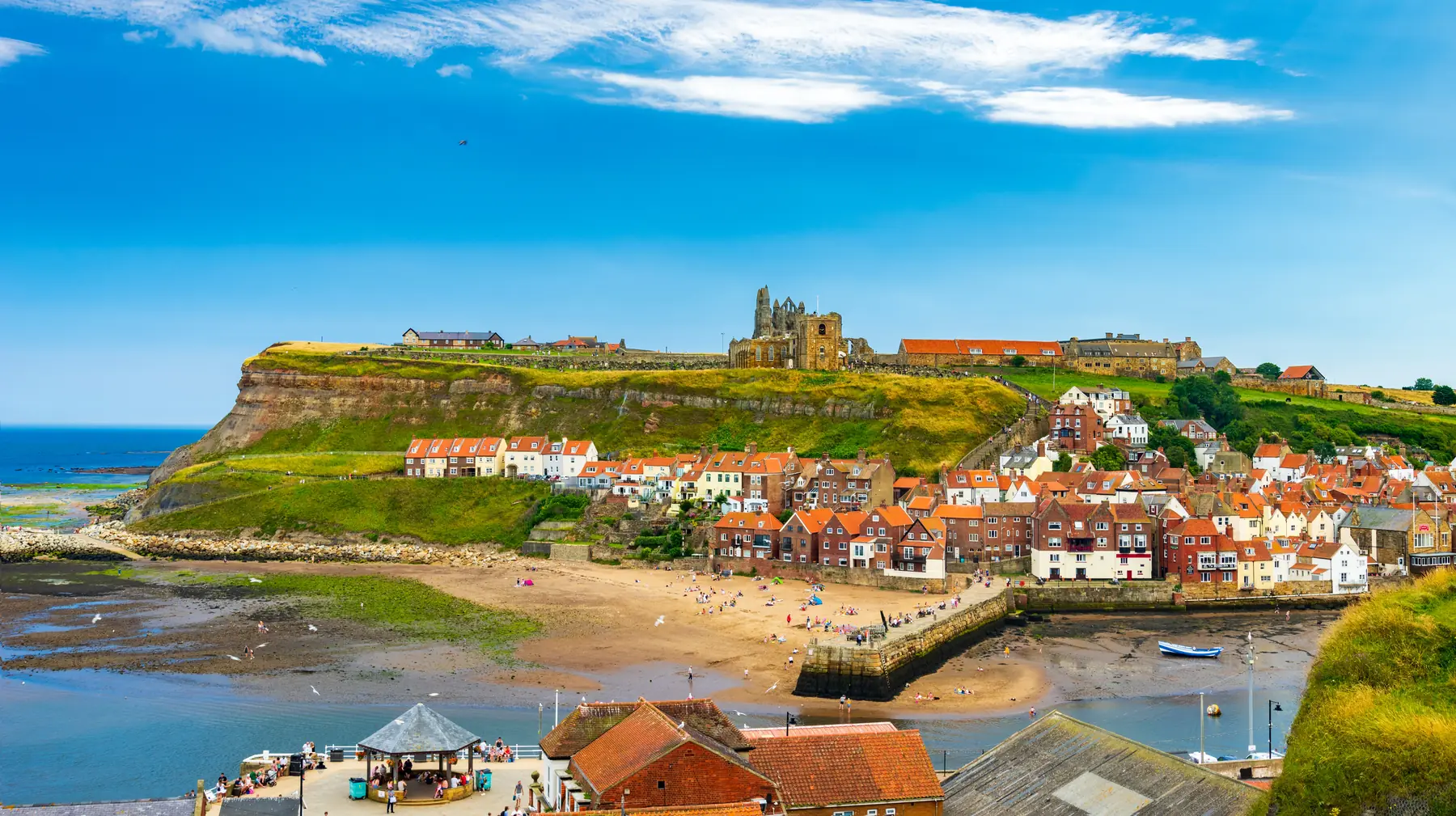
Whitby Abbey is the thing people point at from the other side of the harbour. The ruin sits on the East Cliff, a Benedictine church on the site of a monastery founded in 657, and it is the reason the town has a skyline rather than just a harbour. It is also an English Heritage site with a ticket gate. A lot of visitors walk up, look at the price, walk around the outside, and leave. That is a legitimate visit. It is not the only one.
This is how the abbey actually works: what you pay for, what you can see for nothing, how to get onto the headland without turning the morning into a queue, and why the wind up there is a planning fact rather than a surprise.
The first house here was Streoneshalh, founded by Oswy, King of Northumbria, with Hilda as abbess. It was a double monastery of monks and nuns, and it was home to Cædmon, the Northumbrian poet. In 664 the Synod of Whitby met on this headland and chose the Roman Easter reckoning over the older Iona cycle. Danish raids between 867 and 870 wrecked the place. It was refounded as a Benedictine abbey after the Conquest; the church you walk through is the thirteenth-century rebuild, not Hilda’s timber. Henry VIII’s commissioners took it. In December 1914 the German battlecruisers Von der Tann and Derfflinger shelled the headland and damaged the ruins while aiming for the coastguard station.
Bram Stoker put the silhouette into Dracula. Mina Harker’s diary calls it “a most noble ruin, of immense size”. That is still what you see from the West Cliff, and it is still the photograph.
The ruin is Grade I listed. English Heritage looks after the precinct. St Mary’s church and churchyard next door are not part of the ticket.
You can walk up the 199 Steps, stand in St Mary’s churchyard, and see the whole east front over the wall. You can walk the clifftop path behind the precinct. You can stand on the West Cliff by the Whalebone Arch and get the classic view across the harbour. None of that needs an English Heritage ticket.
Plenty of recent visitors stop there on purpose. One in July 2026 wrote that they “walked around the outside which was enough for us”. Another the same month: “Didn’t pay to go around the abbey just took pictures from outside.” If you came for the skyline, that is the visit. If you came to walk the nave, it is not.
The churchyard is worth the climb even if you never buy a ticket. The stones are salt-scoured, the cliff is eroding, and the drop behind the fence is real. Stay on the path.
Inside the enclosure you walk the ruined church — crossing, choir, east end — and you get into Cholmley House, the seventeenth-century banqueting hall reworked as a museum in 2002. There is a shop, toilets, and an audio guide. Reviewers who like the ticket usually mention the museum, not the extra three metres of stone. Reviewers who do not like it say you can see most of the ruin from outside, which is also true.
Allow about an hour. One visitor in June 2026 took “about 45 mins to walk around and take photos”; another in April 2026 put it at around an hour. A July 2026 visitor was blunt: “you can get round them quite quickly so it’s not a day out.” It is a headland stop, not a wet-weather bunker.
English Heritage currently lists daytime opening with last entry in the afternoon, and the hours move with the season. Read the official Whitby Abbey page before you travel rather than trusting a figure printed here. Members go in on membership. If you arrive by bus, train or bicycle, English Heritage has at times given a discount on tickets bought at the gate that day — show the travel ticket, or the bike. Confirm it when you get there; offers change.
Do not invent a queue strategy from last year’s blog. One visitor in April 2026 found no queue at all. Another could not get in during Goth Weekend. The difference is the calendar, not the ruin.
The classic approach is the steps from Church Street in the old town, through the churchyard, and along to the gate. English Heritage’s car-free partner puts the walk from the bus station at about fifteen minutes by this route. It is the right way to arrive if you can manage the climb. Our 199 Steps guide covers the count, the benches, and the alternatives.
If steps are the problem, do not use the Donkey Road. Drive or take a taxi to Abbey Headland Car Park (YO22 4JT), run by North Yorkshire Council, on the cliff behind the site. From there it is a short made path to the abbey — a June 2026 reviewer called it “solid pathway all the way up”. Several reviewers recommend this specifically for limited mobility. The open-top tour bus is the other way up; one visitor in June 2026 took it up and walked the steps down.
The headland car park is the sensible abbey park, not a secret. It still fills in summer. Charges there are seasonal — the council currently lists charges from 9am to 6pm, 1 March to 31 October — and the board on the day is the tariff, not this paragraph. More on that in parking in Whitby.
The ruin is open to the sky. A January 2026 visitor found it “open to the elements” and advised careful footing. That is not atmosphere. That is wet stone on a clifftop. Wear shoes with a grip. The wind on the East Cliff is out of proportion to the walk up.
English Heritage runs an events programme on the headland: illuminations after dark in autumn, Dracula performances in summer, Halloween half-term. Goth Weekend fills the town and the queue. If you want the empty nave, pick a weekday morning outside those dates. If you want the floodlit ruin, book the event and treat the ordinary ticket as a different visit.
The café at the top of the site is run by the youth hostel, not the abbey. A visitor whose father used a wheeled walking frame was not warned that the path up to it was “all stones and very narrow and bumpy”. Ask at the visitor centre if access is the question.
The ruin is the photograph. The museum is why a ticket is not only a closer look at the same stone. Cholmley House — the seventeenth-century hall on the precinct — holds the finds, the story of Hilda’s house, and the later abbey. Reviewers who thought the entry fair usually mention this room, not the extra metres of nave. Reviewers who thought it dear usually never went in.
If you are paying, read the museum. If you are not, you are not missing a second ruin. You are missing the objects.
A June 2026 visitor advised walking “away from the coast around the pond to get a great view back of the Abbey”. That is the picture that is not the same as everyone else’s from the churchyard wall. Dawn and the last light do more for the stone than a filter. The headland is a windy studio; tripods on the wall in a westerly are how you lose a camera.
Drones over a crowded ruin on a bank holiday are a nuisance. If you fly, do it when you would also have the car park.
Do not come only for Goth Weekend and expect a quiet nave. Do not skip the churchyard because you bought a ticket — the graveyard is half the atmosphere, and it is free. Do not wear city shoes after rain. Do not treat the cliff fence as a viewing platform.
Do the abbey first if you are buying a ticket, before the coach parties thicken. Combine it with St Mary’s and the churchyard whether you pay or not. Walk the clifftop a little way east if the weather is kind. Then go down — the steps, Caedmon’s Trod if you want fewer of them, or the road — and spend the rest of the day in the harbour, not back on the headland.
A beach morning and an abbey afternoon is a coherent day. An abbey morning and the North Yorkshire Moors Railway is another, because the station is on the far side of town and you will want the legs for one climb, not two.
Do not come only for a photograph of the west front with no sea in it. You can take that photograph at other ruins. The point of this one is the harbour underneath it, and you get that from the churchyard for nothing.
The abbey is the town’s landmark. Pay if you want the nave and the museum. Walk the wall if you want the silhouette. Either way, go up in the morning, watch the wind, and check the English Heritage page for the hours that week.