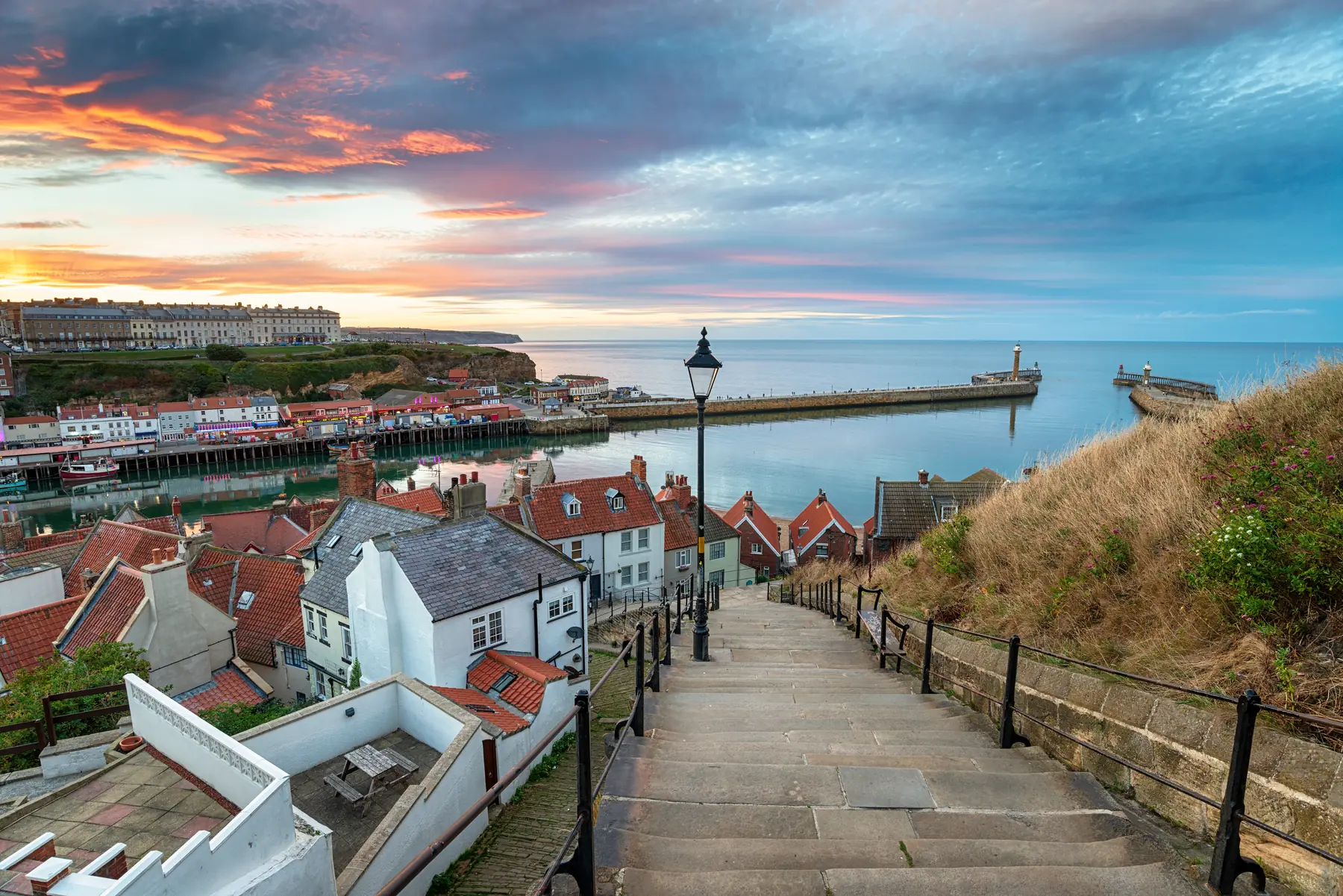
The 199 Steps are the walk that makes sense of Whitby. They climb from Church Street in the old town to St Mary’s Church on the East Cliff, with the abbey just beyond, and they have been the funeral route, the pilgrims’ measure and the tourist climb for as long as the town has had a church on that headland. They are free. They are Grade I listed. They are also a real flight of stone, and people disagree, in good faith, about how hard they are.
This is the climb: what it is, how long it takes, why the Donkey Road is not the easy way, and how to get to the abbey if steps are the wrong tool.
They are also called the Church Stairs, the Church Steps and Jacob’s Ladder. Written records go back to at least 1370; Visit Whitby puts the first record at 1340. Until around 1774 they were wood, painted. An act of 1764 required the owners to pave the route, and 103 tonnes of stone came from a quarry at Sneaton.
This was the coffin road. The level platforms you pass were for pall-bearers to rest the coffin. The last funeral believed to have been carried up this way was that of the Reverend George Austen in 1933. The platforms now have benches, and they are used by anyone who needs a pause.
The climb was read as Christian determination — Sir George Head thought of Bunyan’s Hill of Difficulty. Some of the infirm could not manage it, which is one reason St Ninian’s was built on the west side of town in 1778.
An eighteenth-century act that brought roads under local control left the steps out, so they remain the responsibility of St Mary’s parochial church council. They were renovated in 1988. In 2004 the lower end was sinking; an appeal raised money from 199 donors. Bram Stoker sent the black dog from the wrecked Demeter up them to the churchyard.
They rate 4.8 from thousands of Google reviews. There is no ticket and no gate.
Reviewers split, and the split is the useful information. Some call the treads shallow and the going easier than the number suggests, with handrails and benches. Catherine Taylor, August 2025: “199 steps may seem daunting but tge steps are very shallow and there are plenty of places to stop.” Others call it steep and a workout. Claire Jepson, August 2024, advised anyone with asthma, COPD, or knee, hip or back trouble to take the tour bus to the abbey instead. Mark Neville, June 2025: “Physically demanding, crowded in peak season, slippery when wet.”
Times in the reviews sit between about five and ten minutes for the climb itself. A December 2025 visitor put it at ten; a September 2024 visitor said five. Neither is a race. In high summer the flight is a procession, and you go at the speed of the slowest person in front.
They are stone. They are outdoors. They get wet. They get crowded. They do not get easier because a guidebook called them iconic.
John Wesley climbed them to preach and made it 191. Other counts printed 190, 194, 198, 200. The churchwardens settled on 199 after a restoration in 1877. Every tenth step, and the last, has a small disc with a Roman numeral so you can keep track.
Count them if you like. The number is a local argument that got into the name, not a test.
Alongside the steps runs the Donkey Road, a cobbled slope, also Grade I listed, with a gradient close to 50 per cent. The name may come from beach donkeys being walked down in the morning and up at night. Most of the paving is probably nineteenth century.
Treat it as a curiosity. Claire Cronin, February 2024, called it a route for those “daring enough” to push a pram or wheelchair up. Read “daring” literally. It is not a step-free alternative. It is a cobbled hill with a name.
Abbey Headland Car Park sits at the top of the cliff, behind the abbey. Park there and you walk in on the level. That is the accessible approach to the headland, and it is the one to use if the steps are the obstacle. Details in parking in Whitby.
The open-top tour bus is what Visit Whitby points people to. One visitor in June 2026 took it up and walked the steps down, which is the kinder direction.
Caedmon’s Trod is a third route between the headland and the old town, with fewer steps. A July 2026 visitor mentioned it as the way down. It is not a lift. It is fewer steps.
From the bus station and the railway station you are on the other side of the harbour. Cross the swing bridge, follow Church Street, and the foot of the steps is on Church Lane. Church Street car park is on the same side of the water; Cliff Street is closer in a straight line and on the wrong side. Andy Singh, May 2026: “Difficult to find parking.” He was not wrong. Do not add a parking circuit to the climb.
The flight rises in a long, slightly turning line. The view opens behind you: harbour, old-town roofs, piers, sea. At the top are St Mary’s — oldest parts twelfth century, most of what you see late eighteenth, Pevsner thought this the best approach to it — the churchyard, and Whitby Abbey beyond the wall.
The churchyard is free and, for a lot of people, enough. The abbey precinct is English Heritage and ticketed. You can walk up for the churchyard and the silhouette and never buy a ticket. That is a complete outing.
The clifftop beyond is eroding. The fence sits close to the drop. Stay inside it.
Most people climb for the abbey and treat the church as scenery. St Mary’s is the parish church, oldest fabric twelfth century, most of the interior late eighteenth, a building Pevsner thought this staircase was the right way to meet. The churchyard is the Dracula ground: salt, tilting stones, a cliff that is losing the argument with the sea.
Go into the church if it is open. Read a few inscriptions if it is not. The abbey ticket is a separate decision, and the churchyard does not care which you chose.
Summer days, Goth Weekend, and any weekend with sun in it: the steps are slow. Go early, go late, or go in weather that keeps people in the kipper shops. After rain the stone is slick. In a northerly the top is a wind tunnel.
Down is easier on the lungs and harder on the knees. If you only want to do them once, walk up and ride or drive down, or the reverse.
A February 2025 reviewer gave three stars for poor maintenance and dog mess. That is not the whole story of the steps, and it is not fictional either. They are a working street as well as a monument. After rain they are a wet working street. Hold the rail. Keep the dog on a lead among people who are already out of breath.
The PCC looks after them without being a council highways department. Treat them as a historic staircase you are allowed to use, not as a theme-park ride someone should be power-washing hourly.
Do not run them for a photograph. Do not block a platform to take one. Do not send someone with bad knees up because “it’s only 199”. Do not use the Donkey Road as the accessible route. Do not skip the top because the climb felt like the activity — the churchyard is the reason the climb exists.
The steps are the town’s vertical street. Climb them if you can; use the headland car park or the bus if you cannot; do not let anyone tell you the Donkey Road is the gentle option. Then stand in the churchyard and look at the harbour you just rose out of. That is the point.