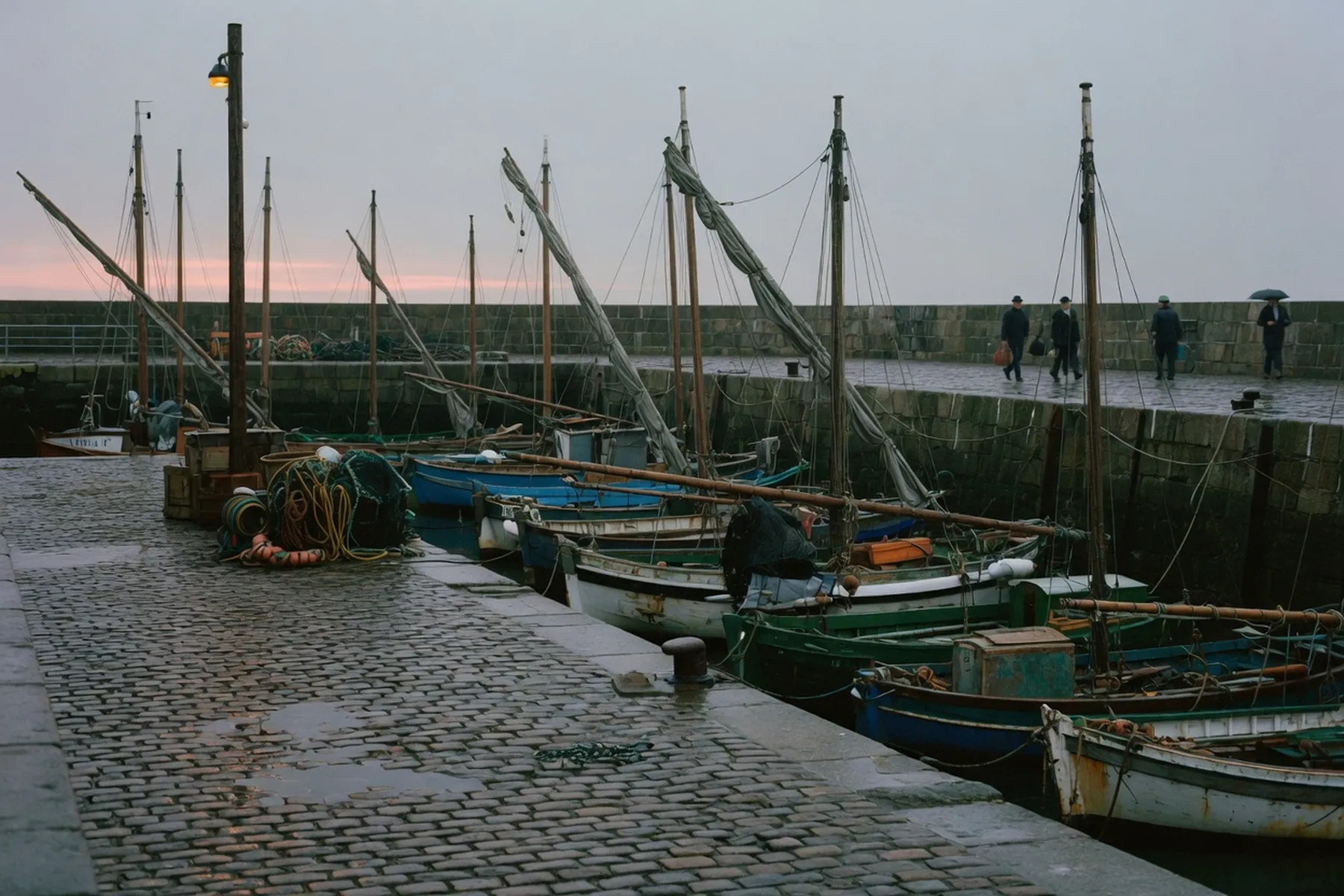
James Cook is everywhere and nowhere in Whitby. Every visitor knows the name, but the man himself left little to point at: a house on a lane near the harbour, a bronze figure on the headland, and a handful of ships that came and went. The town he learned his trade in is compact enough that all of it sits within a short walk, and a morning covers the lot. This guide walks you through the apprentice years, the museum that now occupies his lodgings, the statue on the West Cliff, and the two very different Endeavours — the one that takes passengers out past the piers and the full-size one tied up in the harbour whose future is unresolved.
Cook came to Whitby as a teenager to learn the collier trade under the shipowner John Walker, lodging in the Walker household while he served his apprenticeship. The ships he trained aboard were Whitby colliers, the flat-bottomed, sturdy North Sea coal ships that carried coal down the coast, and it was exactly that hull shape — shallow-drafted and tough, built to be beached and refloated — that later took his name into the Pacific. Whitby’s shipyards built four of the vessels for his voyages, Endeavour, Resolution, Adventure and Discovery, a fact the town has never been shy about: it is cut into a plaque on the statue. Nothing of the shipyard remains to visit, but the apprenticeship house does, and it is the natural place to start.
The Captain Cook Memorial Museum occupies a 17th-century house on Grape Lane, a short, narrow street running towards the harbour, postcode YO22 4BA. This is where Cook lodged as Walker’s apprentice, and the building itself is the exhibit as much as anything in it. The museum is run by a charitable trust and holds Accredited Museum status, which means its collection meets a national standard for care and display rather than being a private display dressed up with the name. The lane is easy to miss from the main street, so aim for the harbour side and look for the small painted sign rather than a grand frontage.
What the visit actually covers is the man’s Whitby years rather than the whole circumnavigation. The attic rooms where Cook lodged, letters and original material from the voyages, and the paraphernalia of a North Sea shipowner’s counting house give the apprenticeship its texture. The story the museum tells is specific: how a grocer’s son from the Cleveland side of the moors became the most consequential navigator of his age by first learning to drive a collier through the North Sea. Give it an hour to an hour and a half rather than rushing it.
The opening pattern is seasonal and worth reading carefully if you are planning a visit in the next few weeks. In 2026 the museum opens Saturday 7 February to Friday 27 March from 10:30 am to 3:00 pm, then from Saturday 28 March to Sunday 1 November from 10:00 am to 5:00 pm. The season ends on Sunday 1 November, and through November the museum is open Tuesdays and Thursdays only, 11:00 am to 3:00 pm, before closing for the winter until early February. Adult admission is £11, accompanied under-16s go free, and school groups pay £7 per child. Last admission is about 30 minutes before closing, and dogs are allowed on leads in the courtyard only — assistance dogs may go inside. Times and prices move, so read the museum’s own visiting page before you set off.
The bronze on the West Cliff, looking out over the harbour and the sea he sailed, is the work of the sculptor John Tweed and was unveiled on 2 October 1912 by Admiral Lord Charles Beresford. It was the gift of Sir Gervase Beckett MP, Whitby’s Member of Parliament at the time, and it holds the distinction of being the first statue of Cook erected in Britain. The figure stands 7 ft 6 in tall, facing the sea with a rolled chart and dividers in hand, the tools of a navigator rather than a fighting admiral. The plinth carries Cook’s posthumous coat of arms — a globe of the Pacific above the motto “nil intentatum reliquit”, he left nothing unattempted — and a relief of the Resolution signed by Tweed himself.
The statue has not always stood where it does now. During the Second World War the headland was a military post and the plinth was damaged, so the figure was taken down and put into safe keeping, returning to its pedestal on 16 August 1947. It was Grade II listed on 4 December 1972 and restored in 2018. The plaques came in stages after that: one in 1968 for the bicentenary of the first voyage, naming the four Whitby-built ships and their crews, another in 1970 for the Australian voyages and a third in 1984 for New Zealand. A separate inscription quotes Tennyson’s Ulysses — “To strive, to seek, to find and not to yield.” Copies of the statue stand in Waimea on the Hawaiian island of Kauai and in Victoria, British Columbia, which tells you how far the Whitby figure travelled as an image.
Not everything called Endeavour in Whitby is a museum piece. The Bark Endeavour Whitby is a 40%-scale sailing replica that takes passengers out of the harbour on short trips, and it is the version most people actually get aboard. Each trip costs £6 and lasts 20 to 25 minutes, carrying up to 46 passengers, with dogs, ferrets and children under two going free. You pay cash or card on board, and there is no booking — sailings run weather and tide permitting, which means the schedule is a list that changes with the sea rather than a timetable you can print. On board, an audio telling runs through Cook’s story while the crew get the shanties going. The vessel was built at Parkol ship building, and the current sailing list lives on the operator’s page, so check it the morning you plan to go.
There is a second, much bigger Endeavour in Whitby, and its story is the one people get tangled. A full-size static steel replica was built in 1993 on the Tees, and after being auctioned she was towed into Whitby in June 2018. For a while she operated as a bar and restaurant, then the company behind her went into liquidation and she was put up for sale, with North Yorkshire Council saying she must be moved from her berth. Her current situation has shifted since and is best not guessed at: what is certain is that the big ship tied up in the harbour is a different vessel from the small one selling £6 harbour trips, and the two should not be confused when you are planning.
Both replicas point back to one ship. The original Endeavour was built in Whitby in 1764 by Thomas Fishburn as the collier Earl of Pembroke, and the Navy bought her in 1768 and renamed her HM Bark Endeavour for Cook’s first voyage of 1768 to 1771. She never came home to Whitby — her later career took her elsewhere and her end is its own argument — but the town’s claim on her rests on the keel, the yard and the men who built her. The Australian-built full-size HMB Endeavour has visited Whitby twice, in 1997 and again in 2002 to 2003, and there is a campaign for a return in 2028, the 300th anniversary of Cook’s birth.
The whole trail is a short, level walk. Grape Lane sits a minute or two from the harbour, the West Cliff statue is reached by the 199 Steps or the road way around, and the Bark Endeavour ties up at the harbour side — the three stops make an easy morning in that order, ending back at the water for a sailing if the tide allows. If you are driving, our parking guide sets out where to leave the car for each of them, and the town is easy to reach without one, as the car-free guide explains. None of the three needs a ticket until you step inside the museum or onto the deck.
For the next few weeks, timing matters more than most of the year. The museum’s season ends on Sunday 1 November, after which it opens Tuesdays and Thursdays only until it closes for winter, so a visit after that date needs to be built around a two-day week. The sailing replica runs tide- and weather-dependent, which in autumn means checking the operator’s page rather than assuming a sailing exists. If you are in town from 30 October to 1 November, Whitby Goth Weekend fills the streets and changes the feel of the place entirely — it is nothing to do with Cook, but it will affect how easily you move between the harbour and the headland, so plan the walk around it.