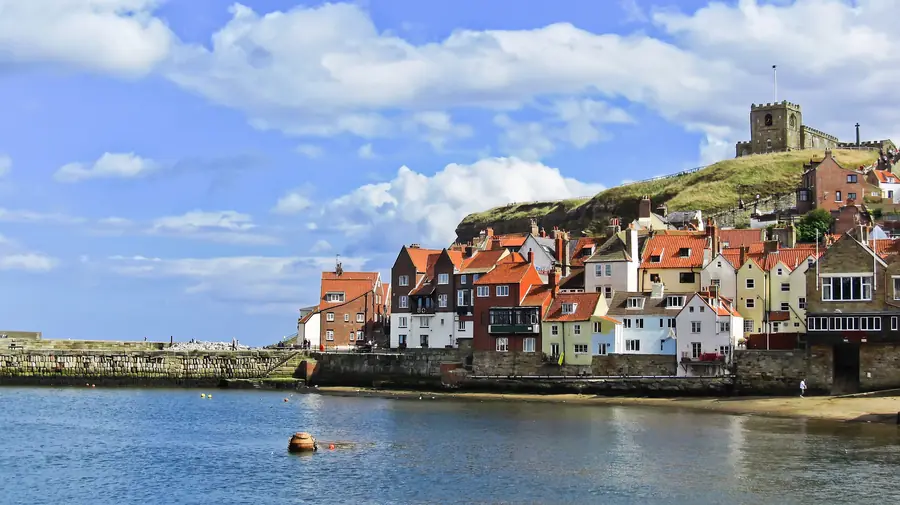
Whitby has four indoor attractions: the Captain Cook Memorial Museum on Grape Lane, Whitby Museum and its art gallery in Pannett Park, the Dracula Experience on the west side of the harbour, and the Lifeboat Museum on Pier Road. That is roughly half a day’s worth, which is the honest arithmetic of a wet visit here: the rest of it is spent in cafés, pubs and shops, because nearly everything Whitby is known for is outdoors.
The town’s headline sights are a ruined abbey on an exposed clifftop, a grade I listed flight of 199 stone steps, two piers, a couple of miles of sand and an arch made from two whale jawbones on the West Cliff. None of that improves in horizontal rain off the North Sea, and Whitby is a hilly, cobbled town where getting between indoor places means being outside again. The practical approach is to pick two attractions rather than four, put a long lunch between them, and keep the afternoon loose in case the weather turns. Whitby is compact and rewarding to walk around, so the distances are short even when the going is unpleasant: the railway station sits about 0.3 km in a straight line from the Captain Cook museum and 0.4 km from Whitby Museum, with those two about 0.6 km apart across the river.
The best indoor hour in Whitby, and the one with the strongest sense of place. The museum occupies Walker’s House on Grape Lane, on the harbour side, a building with a wall plaque recording its construction in 1688 by Moses and Susannah Dring. It belonged to Captain John Walker, the shipowner to whom James Cook was apprenticed in 1746, and Cook came back to visit in the winter of 1771–72 after his first voyage. Cook is said to have studied in the attic by candlelight; the house passed out of the family in the mid-19th century, served as a hospital and a private residence, and became a museum in 1986.
The collection holds original letters about the voyages, including correspondence of Cook, Lord Sandwich and Sir Joseph Banks, paintings and drawings by the artists who sailed with him (Sydney Parkinson, William Hodges, John Webber), Pacific and New Zealand artefacts, charts and ship models. Two ground-floor rooms are furnished to a 1754 inventory of the house’s contents and painted in the original colours. It rates 4.5 from 730 Google reviews. Reviewers consistently single out the volunteer guides: one 2026 visitor wrote that a volunteer went away to research a question he could not answer on the spot. Several mention three or four floors of it, so allow more time than the building’s size suggests.
The bigger and stranger of the two, and the better bet if the rain has set in for the day. It sits in Pannett Park on the west side of town, rating 4.7 from 1,301 Google reviews, and it is a museum of Victorian curios: natural history, local shipping, and an art gallery under the same roof. Recent reviewers describe fossils and dinosaur bones found near Whitby, Victorian jet jewellery, ship models, a gallery on James Cook, old toys, and two objects visitors keep naming, the Tempest Prognosticator and the Hand of Glory.
Reviewers vary wildly on how long it takes, from an hour to half a day. Two hours is a fair planning figure.
A short self-guided walk-through of a dark house with models, sound effects and a film at the end, on the west bank near the harbour. It rates 3.6 from 910 Google reviews, the lowest score of anything in this article, and the reviews explain why rather than condemning it: most people report it taking 15 to 20 minutes, two reviewers in 2025 and 2026 found no live actors on the day despite expecting them, though another in 2026 did, and one noted the interior is so dark that the plaques are hard to read. The visitors who enjoy it are the ones who go in expecting something small, old-fashioned and knowingly camp, with a few jump scares and a short film at the end explaining how Whitby fits into Stoker’s novel. A 2024 reviewer warned it would be difficult for anyone with mobility problems. Go if you have children of the right age or a fondness for seaside kitsch; skip it if you want a museum.
The Whitby Lifeboat Museum on Pier Road occupies the double boathouse used by the local lifeboat service between 1895 and 1957. The modern lifeboat station is across the river on Church Street.
If you want something that fills a solid hour regardless of the weather, Eskape Whitby is an escape room centre rating 4.9 from 118 Google reviews; one family review recommends it specifically for when “the weather is rubbish”. Whitby Distillery runs tours and rates 5.0 from 271 Google reviews, and one reviewer booked the tour because a rainy weekend prompted it, and another recommends it as a rainy-day option. Both need arranging in advance rather than turning up.
Whitby’s independent cafés are the real wet-weather infrastructure. The Magpie Café on Pier Road is the famous one, 4.6 from 9,434 Google reviews. Quieter alternatives: Sherlocks Coffee Shop off Flowergate, 4.6 from 1,377; The Singing Kettle in Angel Yard off Baxtergate, 4.8 from 1,011; Rusty Shears on Silver Street, 4.7 from 988; Mr Cooper’s Coffee House on Church Street, 4.8 from 760; and Monks Haven, also Church Street, 4.6 from 743. Botham’s of Whitby on Skinner Street is a bakery, 4.7 from 1,012 Google reviews.
For a longer sit-down, Trenchers on New Quay Road rates 4.6 from 7,484 Google reviews and Humble Pie n Mash on Church Street 4.7 from 2,494. Pubs that suit an afternoon: the Black Horse Inn on Church Street, 4.5 from 1,340; Little Angel on Flowergate, 4.5 from 1,964; The Endeavour on Church Street, 4.5 from 1,820; and The Granby on Skinner Street, 4.4 from 1,545. Kippers are a Whitby speciality, and the smokery at Fortune’s is on Henrietta Street past the abbey steps.
Go straight up to the headland. Whitby Abbey, 4.6 from 15,360 Google reviews, is the seventh-century monastic site founded in 657 by Oswy of Northumbria under the abbess Hilda, refounded as a Benedictine house after the Norman conquest and dissolved under Henry VIII. It stands on the East Cliff over the North Sea and looks its best under moving cloud. The 199 Steps climb from the head of Church Street to St Mary’s Church; every tenth step and the final step carry a small disc stamped with a Roman numeral so you can keep count. If wet stone puts you off, the slope alongside them, the Donkey Road, is the alternative, though it has a near-50% gradient, and Green Lane reaches the abbey without steps at all.
The piers are the other thing to do in a clearing sky. The West Pier rates 4.9 from 77 Google reviews; visitors mention warning signs against standing near the barriers in bad weather because waves come over the walls, and one noted the planks towards the pier end are widely spaced, so mind your phone. Take a coat regardless. Whitby weather turns quickly in both directions.
For a day, yes, if you accept that you are doing a museum day rather than a Whitby day. For a whole weekend of rain, the town runs out of indoor attractions quickly and you will be leaning on cafés, pubs and shops.
Whitby Museum in Pannett Park, on volume alone: it has more rooms, an art gallery, a café and enough oddities to absorb two hours. The Captain Cook Memorial Museum is the better building and the better story, but it is a house, not a large museum.
The car parks nearest the two halves of town are Marina Front and Marina Back on Langborne Road, Church Street on the east bank, West Cliff on Royal Crescent, and Abbey Headland up on the East Cliff. The Park and Ride on Guisborough Road rates 4.8 from 968 Google reviews and is the standard advice for busy days, though it is seasonal, so check before relying on it out of season.