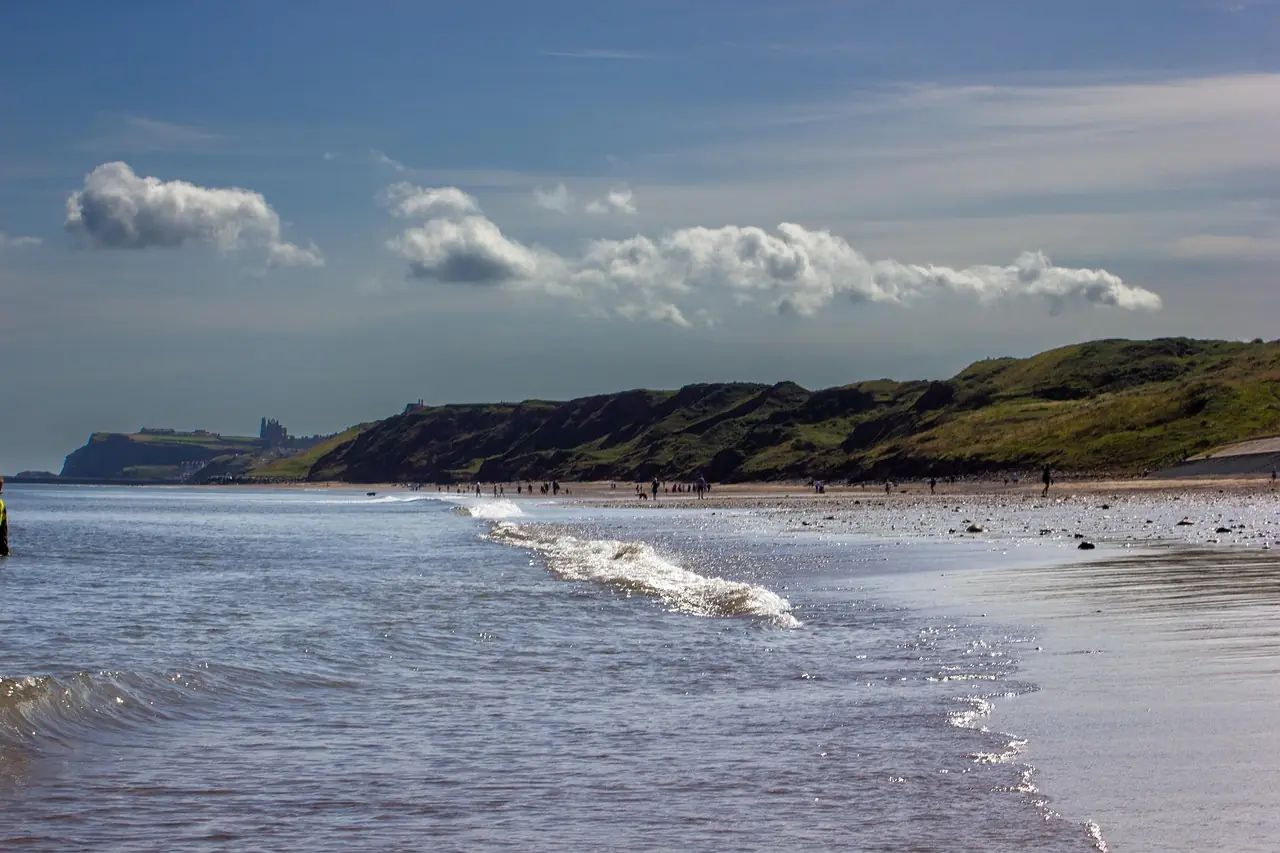
Whitby Beach is the long run of sand under the West Cliff, north-west of the harbour, with the abbey on the opposite headland and the piers closing the view east. It is free, it is sandy, and it is the thing a lot of people came for after the ruin and the fish and chips. It is also a tidal North Sea beach at the foot of steep ramps, and both of those facts catch visitors who treated it as a municipal lido.
This is the beach day from town: how to get onto the sand, where the dog rules fall, why the tide is the planning document, and when the walk to Sandsend is a pleasure rather than a scramble.
What the signs call Whitby Beach is the town’s own: below West Cliff, reached from the ramps, the cliff lift when it is running, or along from the harbour. Beach huts, a pavilion, lifeguard cover in season, deckchairs for hire on a dry day. It rates 4.7 from thousands of Google reviews, which is the score for a wide sandy beach on a working harbour, not for the Caribbean.
Walk north-west and, at low water, the sand continues through Upgang towards Sandsend, a few kilometres up the coast. That continuation is the walk people rave about and the one that needs a tide table. East of the piers, the East Cliff foreshore at low tide is rock pools and fossils, not a picnic blanket, and the tide comes back fast.
The abbey sits on the cliff opposite. You will photograph it. The photograph will not show the ramp you just came down.
This coast is not a pond. A June 2026 reviewer “mistimed and nearly got stuck with high tide”. Another, in June 2025, warned that in the shadow of the cliffs there is no mobile signal, “so take that into account when on long walks or exploring coves, and check the times for high tide at Whitby online.”
Check a tide table for Whitby before you set off, and turn back with margin, especially if you are walking towards Sandsend or onto the East Cliff scars. The local beach notes flag a strong along-shore flow past the beck at the Sandsend end, a shore dump at the water’s edge, and a rip off Sandsend Ness that the same notes say washes people out every year. Their advice for that end is not to swim at all. The town stretch is a different proposition — more below — but the walk to Sandsend is the same sand.
Do not count on a phone in the cliff shadow. Tell someone the plan.
The West Cliff car parks sit above the beach. The way down is a set of long ramps. Three of the reviews in the attraction sample call the path steep; one visitor in August 2023 gave three stars because the beach was “hard to access without walking further along due to a steep path”. Another, in November 2025, called the access easy. Both can be true depending on knees and the particular ramp.
The cliff lift is the other option, and it is seasonal and mechanical. Local notes qualify it with “if it’s running”. Do not build a day around it without checking.
From town it is a short walk plus the drop. From the railway station it is further, with the climb onto West Cliff first. Straight-line distances hide the gradient. If you have a pushchair, the ramps are work. If you have a wheelchair, look at the lift’s current status and the promenade, not at a photograph of sand.
Parking for a beach day is West Cliff, Pavilion Drive or North Terrace, or the park and ride if those are full. A June 2026 reviewer called parking a “nightmare specifically in mornings” and found machines out of order. That is Whitby in season, not a unique failure of the beach.
Dogs are restricted on the main stretch in summer. Reviewers describe a ban from around the start of May to the end of September, with a small permitted section left — one visitor in June 2025 found it “the size of a postage stamp” and walked about a kilometre and a half towards Sandsend before reaching usable sand. Outside those months, people walk dogs here happily.
The lines and dates are the council’s. Read the signs at the entrances on the day rather than this paragraph, a Facebook group, or last year’s stay. Fines are not theoretical; one reviewer mentioned a four-figure figure. Upgang, the middle stretch, is the year-round dog sand if the signs still say so when you arrive. Tate Hill, east of the river, is a different beach.
The local beach guide rates the Whitby town stretch as relatively safe, with a lifeguard on duty in summer, in contrast to the Sandsend end. Relatively safe on the North Sea still means cold. Reviewers in June 2026 and August 2025 both said so. There is sometimes surf. There is a current along the shore.
If you are not a sea swimmer, paddle and stop. If you are, swim where the lifeguards are, not out towards the ness because the sand looked emptier.
Seagulls will try for chips. That is not a safety briefing. It is still true.
At a falling tide this is one of the best short walks on the coast: sand the whole way, the cliffs on your left going out, a village with cafés at the far end, and the same sand back. An August 2026 visitor “love[d] walking along the beach all the way to Sandsend for a cup of tea and cake before heading back.”
Do it on a rising tide and the same walk becomes a negotiation with rocks and a shrinking strip of sand. Sandsend itself is the easier beach to reach by car — no steep cliff path — and our Sandsend page covers the village. The Arriva 4 and X4 run up the coast if you want to walk one way and ride the other.
Give it longer than it looks. Soft sand is slower than a pavement.
The coloured beach huts, the pavilion, and a large blue building with toilets and a café are the furniture of the town stretch. Deckchairs and windbreaks appear on dry days; beach mats are sold in the shops on the cliff. None of this is the point, and all of it is useful with children who will not sit on sand.
The Spa and the West Cliff lawns sit above you. The Whalebone Arch is a two-minute walk from the top of the ramps. Combine them. Do not carry a folding chair down a ramp you cannot carry it up.
Beyond the east pier, low tide uncovers scars and pools. Fossils turn up, especially after winter storms. The tide returns fast, the rocks are slippery, and this is not the children’s paddling beach. Stay near the pier access unless you know the foreshore.
The West Pier is a walk in its own right, with a fishermen’s memorial and a view back to the abbey. Reviewers mention wide gaps in the decking near the far end and waves over the barriers in rough weather. It is a harbour pier, not a lido promenade.
The town sand at low tide is large. A June 2026 reviewer said it was “unlikely to get overpopulated or cramped as it follows the head land for over a mile complete with rock pools.” High tide eats that. With small children, pick a falling tide, stay near the ramps, and treat Sandsend as next year. Donkey rides appear in season on the local listings; they are not a beach plan, they are a five-minute photograph.
Rock pooling is better east of the piers or at Robin Hood’s Bay, with the same tide warning.
Low tide in the morning, walk towards Sandsend or sit on the town sand, back up the ramps for lunch, abbey or harbour in the afternoon. High tide in the morning is a pier walk and a wait. School holidays fill the sand nearest the ramps; walk ten minutes and it thins.
The beach is free. The car parks are not. The tide does not care. Check the table, read the dog signs, and treat the ramps as part of the walk rather than an insult.